

May 2026 Recap
The Good, The Bad and The Ugly + (AI AI AI)


May could be categorised as many things, hence my reference to the classic spaghetti western movie, The Good, The Bad and The Ugly. May is the moment you realise you are almost halfway through the year, which means another grading session for how well you performed in the quarter and also at half year (The Bad).
I made it to the Middle East. The trip had its own ups and downs, but I was once again inspired by the vision, openness and hospitality of Dubai. Despite how modern Dubai is, it is still rooted deeply in Arabic culture. It is also a remarkable reminder of what vision can achieve: a global destination built in the middle of the desert, literally out of nothing. Whilst there, I visited another GAIA, this one, a Greek-inspired restaurant co-founded by Nigerian-born Chef Izu which was lovely. I also managed to cross something off my wishlist (The Good).
AI is still dominating so many digital conversations and spaces: Instagram feeds, LinkedIn posts, and Reddit threads. Unless you are a creative and then maybe you are only talking about it slightly less than everyone else. The level of AI content seems to have taken another exponential leap, or maybe it’s just my algorithm. Either way, it is everywhere: vertical fiction dramas, personal avatars, tips and tricks for all the main platforms, except strangely Microsoft’s Co-pilot 😅. Increasingly, it’s also appearing in places perhaps it shouldn’t: prestigious literary prizes and allegedly the New York Times Modern Love column (The Ugly).
Highlights
Click to jump straight to a specific section
My Discovery List - Discover new books, ideas, articles, Substacks, music, movies and podcasts, through a curated list.

Does It Pay to Stay? The Loyalty Question
Someone on my team recently reposted a LinkedIn post on this topic. The post has since been deleted, but it prompted me to reflect on a question that sits at the intersection of leadership, employee experience and organisational behaviour. As an individual who is both responsible for talent decisions and subject to them, I want to understand both the sentiment surrounding this topic and what the research actually says about loyalty, contribution, and reward?
The consensus online feels clear. LinkedIn coaches, HR experts and employees seem firmly camped in the “it does not pay to stay” camp. Conventional wisdom agrees because, historically, there is truth to this. Across many labour markets, external hires have often been rewarded at current market rates, while existing employees have been rewarded based on internal pay structures and historical expectations. The result is both the perception and, often, the reality that the labour market rewards mobility.
What’s interesting is how things have evolved over the past few years. The broader global pattern indicates that the financial premium associated with switching jobs has narrowed considerably as employers have slowed hiring and labour markets have weakened. Employers have also become much more cognisant of the cost of employee turnover, especially when it comes to replacing experienced people whose knowledge, relationships, and institutional memory are hard to replicate and as such have engaged in retention-focused practices that materially reduce turnover. Simultaneously, employee priorities are shifting, with people placing greater emphasis on career development, flexibility, wellbeing and financial progression than previous generations may have done.
The business case for keeping high performers engaged, rather than assuming they will stay on goodwill alone, is strong. This matters because employee loyalty is not just about tenure. Employee loyalty is the result of a combination of factors that shape retention and engagement: growth opportunities, consistent recognition, fair compensation, work-life balance, and leadership quality. In other words, employees remain loyal because they can see a future, feel valued, and their contribution is recognised.
People leave organisations for many reasons, and feeling undervalued is often one of them. I sincerely hope that is not what was behind this particular post, but it did prompt me to reflect on a broader question: Do organisations adequately reward the people who choose to stay?
Employees who contribute beyond the boundaries of their job descriptions often create significant value. They mentor new colleagues, preserve institutional knowledge, support team culture, and provide stability during periods of change. These same people often receive strong performance evaluations, yet are not always rewarded proportionately through pay or promotion. This creates a strong perception that organisations price external talent at market rate and internal talent against historical expectations.
There are understandable reasons for this dynamic: including hiring pressures, weak career management processes, or the tendency to overlook the value of people who contribute in ways hard to measure. Additionally, external candidates are often at their most visible during a hiring process, actively articulating their achievements, presenting their strongest examples, and negotiating their value. Existing employees, in contrast, may assume that years of contribution speak for themselves and expect their impact to be recognised without having to market it. They may also already have benefited from years of investment in development, training, and opportunities that are not reflected in their current compensation, complicating the question of what is a fair compensation in this case. Whatever the cause, the perception that it pays more to leave than to stay is a powerful one.
I recently watched a short clip on Instagram with the CEO of Oando discussing talent decisions. His point was straightforward: tenure and contribution are not the same thing. In his example, multiple people, including a long-serving employee who had stopped growing, were ultimately exited, while high performers were retained. There’s also a hilarious moment at the end of the clip, where his employee comments, “you basically fired everyone!”. Funny, but again pointing to the importance employers place on contribution and performance.
As leaders, our responsibility is ultimately to the organisation and its stakeholders, which includes the employees. Our goal should be to adequately reward those who continue to contribute over time, not just those who hang around. If we want employees to remain engaged, then we must regularly audit salaries against the market, create clear career pathways, recognise performance consistently, and ensure the people doing the difficult, often invisible work of keeping things running are not overlooked.
If an organisation is intentional about rewarding sustained contribution, the message employees will hear is: stay.
AI At Work And Everywhere Else
I recently came across a piece on Substack that mentioned how AI reduces the friction of starting. Around the same time, I saw a post on Instagram from a team manager suggesting that, because of this, some employees are producing more work without doing the actual work of editing and refining it to deliver on the intended goal. The result? More work for managers.
I use AI for work. Almost everyone in my office uses AI for work. There’s a clear distinction between people on the team who use it to support their delivery on a goal versus those who don’t. That difference is understanding. Those who understand the goal and the deliverables use it as a tool to produce tighter, more competent and goal-aligned work. Those who don’t understand often produce more content and meet deadlines at a faster rate, but do not often produce better work. The other day I received a ten-page document to support a decision that only required 1-2 pages. I also sometimes receive emails that read like essays instead of being brief and to the point.
I once laughed when I saw an email response that was just AI-to-AI correspondences. One person had clearly used AI to draft an email, and the other had used AI to draft a response, and it looked like neither of them actually read what the other wrote. It was efficient, but does this type of efficiency yield better outcomes or just more activity at a faster rate?
A similar dynamic seems to be playing out beyond the workplace. AI-generated content is everywhere. From short-form video content to thought pieces, literature, art, and more. The volume of content being produced has exploded because the “cost” of producing it has collapsed. I love to see the many creative ways that people are using AI, but I also think there’s now so much questionable content out there because the friction required to produce anything has been reduced so dramatically. Good for some things, not so good for others.
This raises another question. As AI becomes embedded in how we write, think, communicate, and create, how much of that should be disclosed? It’s clear AI has changed a lot of things, and will continue to do so. There has been a lot of resistance to AI and in some cases I’m not sure resistance is the most productive frame. AI is already changing language. It is changing writing. It is changing how ideas are produced and distributed, some of which is positive. A more useful conversation would be about developing norms around when and how AI use should be disclosed.
Using AI to help structure a report at work is not the same as using AI to write a novel submitted for a literary prize. Using AI to refine your writing is not the same as asking it to generate the writing itself. Yet we often talk about AI use as though it exists in a single category. I used AI the other day to generate some images of myself from old photos I had, so I could use them online and my friend jokingly teased me about it. It took me about 15 minutes and solved a problem quickly. I have also had professional headshots done, and while they were much more expensive, they served a completely different purpose. There is space for both. They meet different needs.
AI has made producing several things easier, but it has not made discernment, taste, strategic thinking, or judgment any less valuable. If anything, it will increasingly make them more valuable.
Events in May


Mixta Africa Partnership Event From Blueprint to Legacy: Women Building Wealth Through Sustainable Real Estate. My second partnership event of the year. This time on wealth building in real estate. Speakers included Sade Hughes, Country Manager Mixta Africa, Olajumoke Akinwunmi, Co-Founder/MD Alitheia Capital (panelist), Andrea Cameron-Cole, Head of Sales Mixta (panelist), Gladys Ameh, CEO Brookehouse Designs (panelist) and Tolu Adebule Head Commercial Strategy Team Mixta (moderator). This panel discussion was humorous and insightful, helping members and guests to understand how African women think about assets, inheritance, and building for the long term. It was really a pleasure to coordinate with the Mixta team, especially Nneoma Anaeto who also helped to coordinate the event.
Two key takeaways: how to start small on the property ladder and an interesting idea from Andrea on community real estate purchases: a model where a group of friends, siblings or colleagues pool resources to purchase property as an investment.
GAIA Unbowed Magazine Was Published
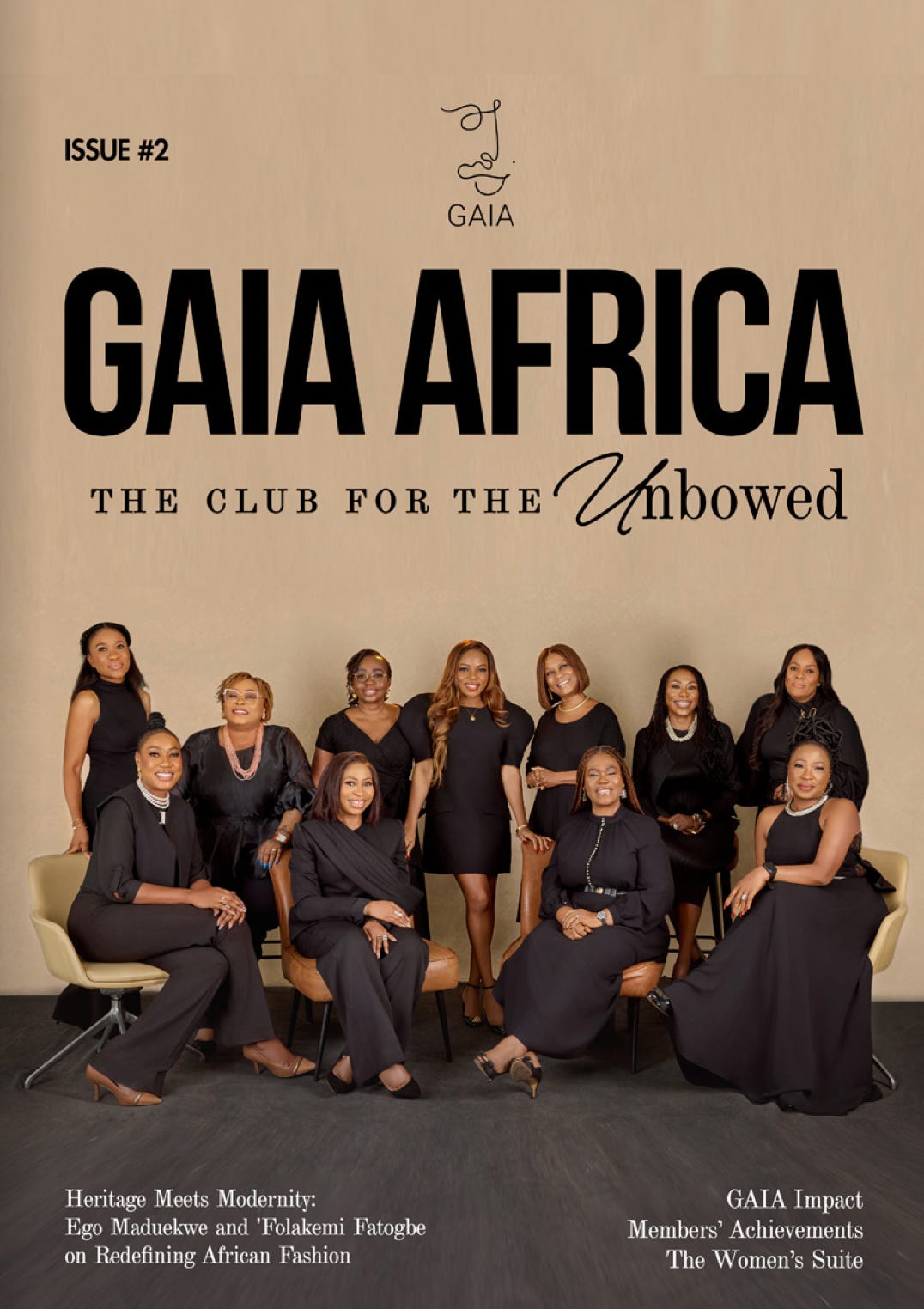
A long time coming, but Edition 2 of the GAIA AFRICA Magazine is finally here. It was a pleasure to work on this alongside members of the team, with creative direction from Toheeb Balogun. The publication brings together stories of leadership, entrepreneurship, impact and ambition from across the GAIA community, and I’m incredibly proud of what we created together. Front cover image by Yagazie, founder of Gazmadu Studios. Read the full magazine here:
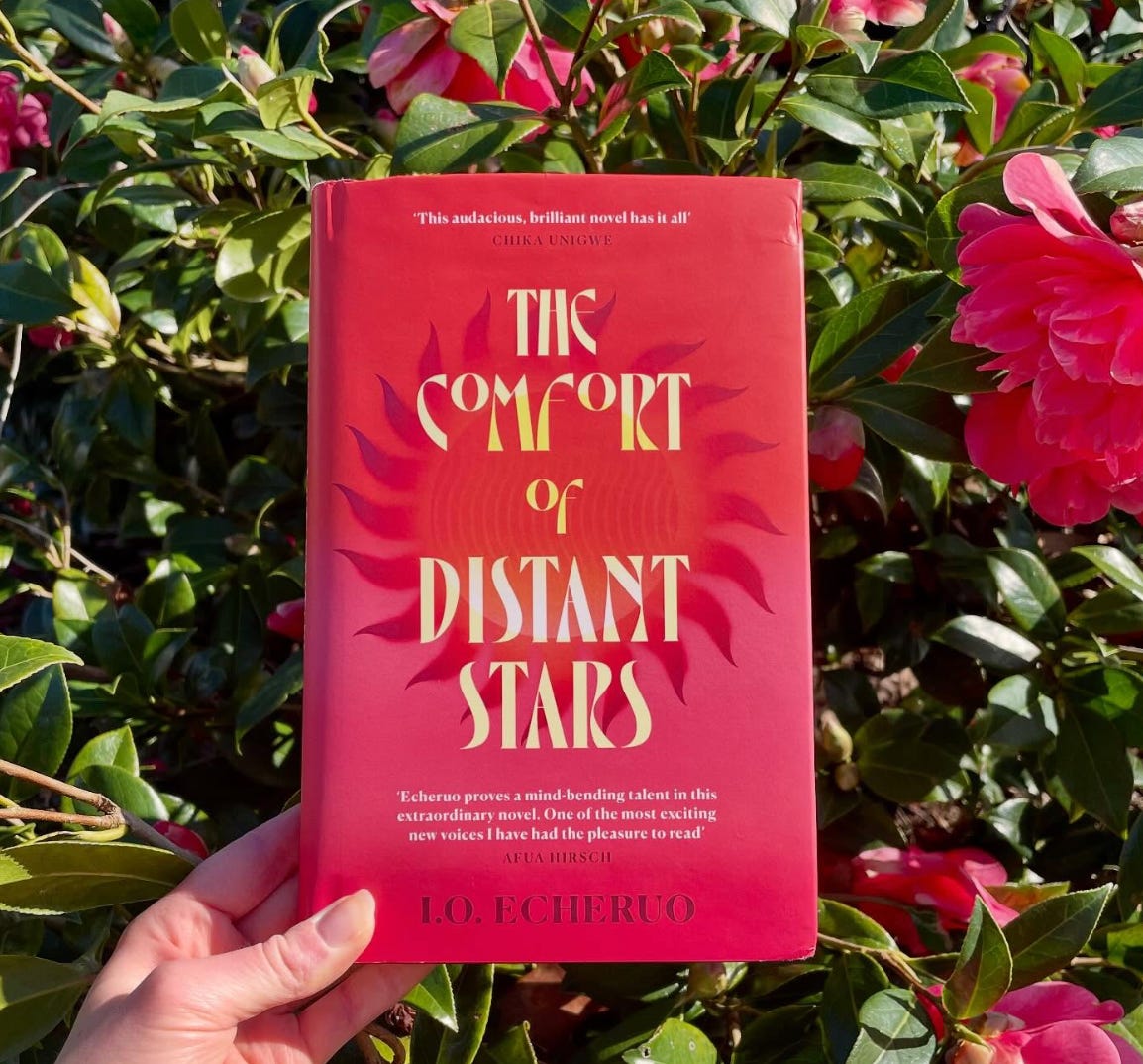
Authors’ Series — Ike O. Echeruo, The Comfort of Distant Stars. This is the first of the Author’s Series of the year, following the inaugural event in 2024, where I interviewed Kehinde Fadipe on her debut Novel In Such Tremendous Heat. As an avid reader, I appreciate having literary events at work. Echeruo’s debut novel has been shortlisted for the 2026 Orwell Prize, which is significant. He was also featured in the Financial Times in March as one of the best new debut novels.
Citi Bank : The Short and Long: Navigating Markets
There seems to be an increasing number of International private bank events in Nigeria, which I think is a good sign. This event was intimate, to the point and informative. Citi’s Chief Investment office broke down what’s driving the market and what taking the long view on wealth building means.
May’s Gentlemen’s Thursday: The Secret Behind Partnerships That Endure
Moderated by Nnennia Ejebe, Partner Aden Partners, this panel featuring Dan Agbor, Legal luminary, Non-Executive Director at UACN Plc and Sola Adepetun Founding Partner at Dentons ACAS-Law was a real firecracker! The discussion repeatedly returned to two core themes: trust and alignment. I quite often think of partnerships as marriages, you need to have the same values, get along to a very good degree, and be absolutely aligned on the vision of the enterprise.
It was also interesting to hear how their leadership and management practices have evolved over time, their approaches to talent retention 🔥, and their reflections on Gen Z employees, particularly how they’ve adapted their organisations and systems to better accommodate this new generation of talent.
My Discovery List
Brands


GAIA Dubai - Nigerian born Chef Izu Ana is the driving creative force behind this hospitality brand. I had the pleasure of eating at his restaurant in Dubai on my second to last night there. The service was exemplary, and the wine and food were very good. It was also très chère!


Saint Laurent - I have a delicious wishlist that ranges from things like eating very specific foods in certain cities to items I would like to purchase. I can now strike one item of that list. Which ones do you like the most and which do you think I got?
Books
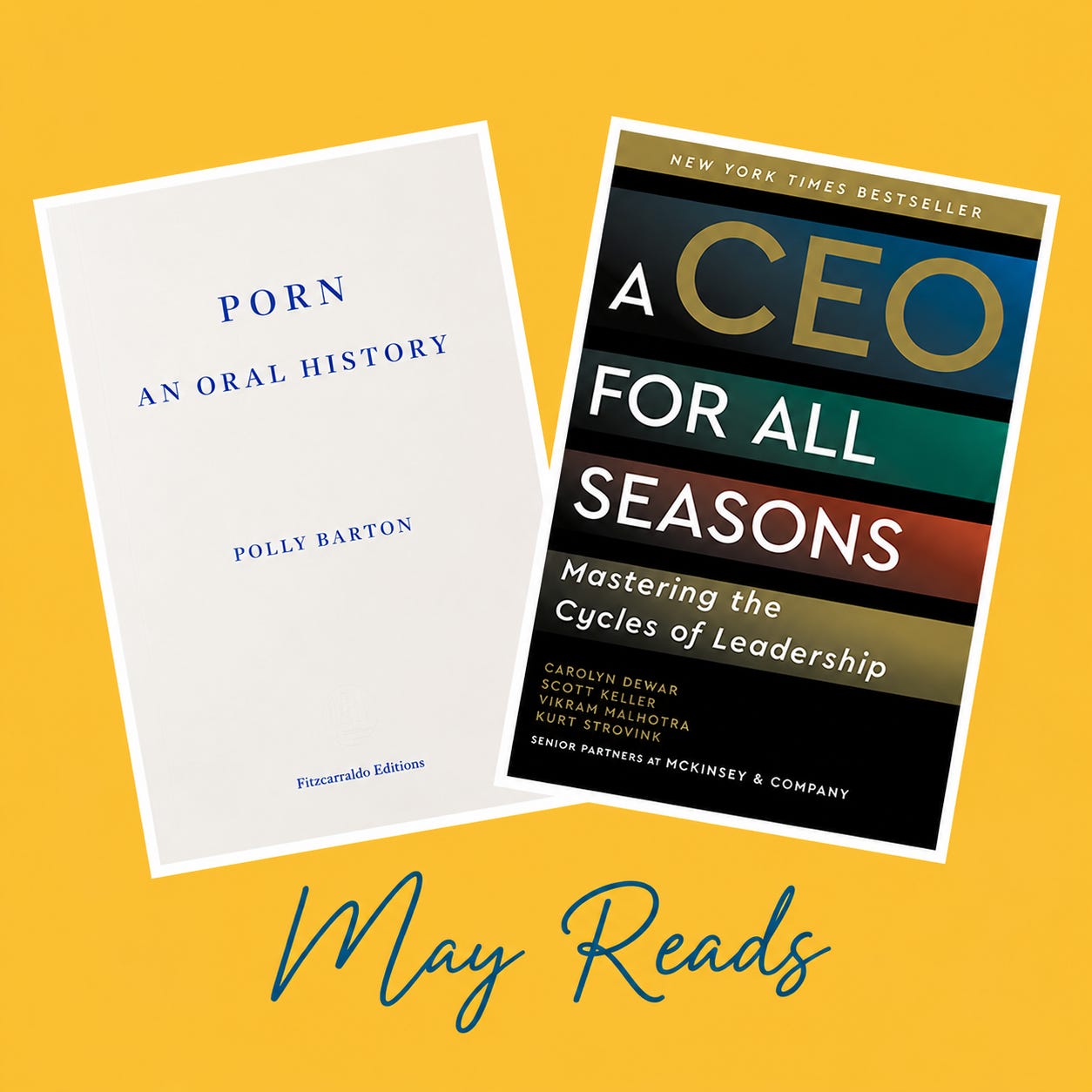
Porn: An Oral Tradition, Polly Barton Barton is an interesting writer. I didn’t know what to expect from this book when I bought it, except the cover and title caught my eye. I bought this book, before I bought Fifty Sounds, but read the latter first. If you have ever lived in a place where you have had to learn the language or you are a japonophile read Fifty Sounds. Porn is a book for people interested in conversations; the kind friends, lovers and strangers have. Barton’s premise is simple, if porn is everywhere, why is no one talking about it. I cringed, laughed and sometimes squealed whilst reading this book. I also thought a lot about intimacy, vulnerability, societal norms, the things women and men do, cultural differences and Barton’s premise.
CEO for All Seasons, Carolyn Dewar et al. Well-researched, including insights from some of the world’s best and most venerated CEOs. Also a good take on what the job of leading an organisation actually requires across the years. I listened to the audiobook version on Spotify.
Articles / Substacks

I moved to Claude because I prefer its interface; it feels more human. I kept ChatGPT, because I wasn’t sure how the Claude trial would go and now have both. I’m aware having two AI LLMs might be considered superfluous, but I find it useful. AI is constantly evolving and mini-research articles like this help to understand the nuances between one model and the next. I also believe one of Ruben’s other articles may have been where I saw the comment about friction.
10 Travel Writers, 10 Favorite Hotels - A very old article, but my head was in holiday mode as I dreamt of all the places I could visit this August.
The Brothers Made Virginia Wolf the Talk of Cannes - I’m in a movie that made it to Cannes!!! What can one say, French Riviera here I come. Extremely proud of my friends for this huge win and looking forward to its release in Cinemas.
PCOS, is renamed as PMOS - This is significant news in the world of women’s fertility issues as about 10-13% of women of reproductive age worldwide suffer from Polycystic Ovary Syndrome. The new name, PMOS, Polyendocrine Metabolic Ovarian Syndrome, better categorises the complex nature of this hormonal and metabolic disorder and hopefully will widen up the scope for treatment / therapies.
Thanks for reading Her Journal! Subscribe to catch the next interview, stay updated on my life in a leadership role and access curated resources
This is quite an insightful write up Mena, absolutely enjoyed reading it.
The conversation about AI is everywhere and I'm constantly trying to gauge where to draw the line... I see a lot of good in the medical sector eg using AI to detect things the human eye can easily miss. But then I see quite a lot of ugly and bad, and their future impact on humanity. Guess we'll have to see!